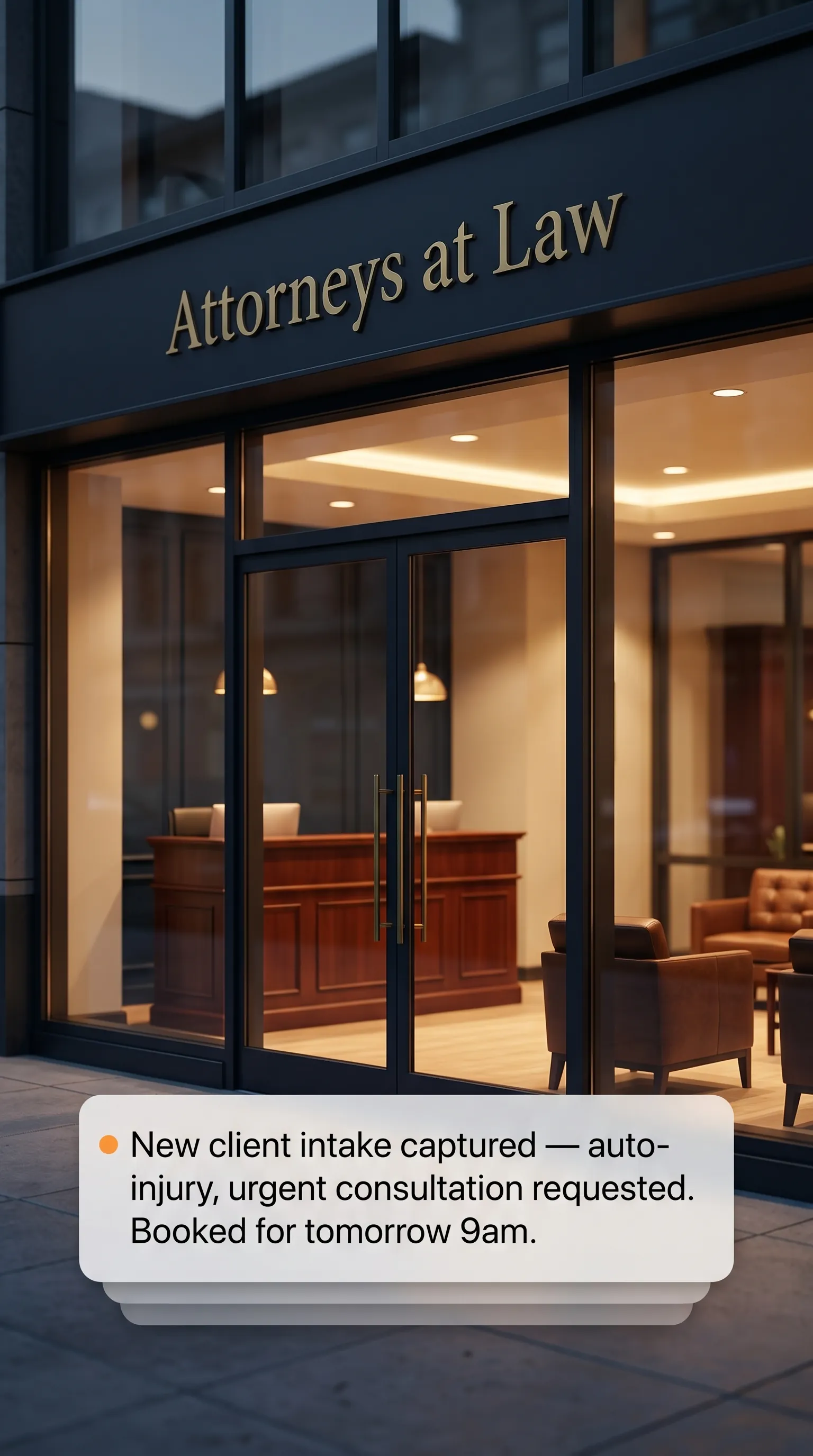
At 9:23pm on a Sunday in your area, a 34-year-old driver gets T-boned at an intersection by a delivery van that ran the light. She's shaken, the police are still on scene, the insurance card is in her purse with a phone number she doesn't recognize, and she has her cousin's voice in her ear saying "you need to call a lawyer tonight, before you talk to their insurance company."
She Googles "personal injury lawyer near me" while sitting in the back of the ambulance. The first five results are sponsored ads. She calls the top one. Voicemail. Tries the second. After-hours answering service that takes a message. Third. A real attorney answers in three rings — "Madison Law Group, this is Daniel, are you OK?"
By the next morning Daniel's firm has signed the engagement letter for what turns out to be a $340,000 settlement case over the next 14 months. Your firm's name was further down the search results. By the time anyone at your office heard about the case, the engagement was already signed.
How much did that miss cost?
The single intake call math
Personal injury intake is unlike any other call type in the legal industry. A few reasons:
- The case value is enormous compared to most legal work. Median PI settlement in the US is in the $20K-50K range. Serious injury cases routinely run $200K-$2M. Wrongful death and complex multi-party cases far higher.
- The contingency model means every signed case is pure revenue. Standard PI contingency is 33-40% of settlement.
- The intake call is the entire sales cycle. Unlike a real estate or B2B deal, the call IS the conversion event. The first attorney to demonstrate competence in the first 90 seconds usually wins.
- The caller is in genuine emotional state. They want to feel cared for. They want competence. They want certainty that someone is on their side.
Per-call economics:
| Case type | Likely settlement range | Firm revenue (33% contingency) |
|---|---|---|
| Minor injury, clear liability (rear-end, slip-and-fall) | $15,000-50,000 | $5,000-16,500 |
| Moderate injury, contested liability | $50,000-200,000 | $16,500-66,000 |
| Serious injury (broken bones, surgery, time off work) | $200,000-800,000 | $66,000-264,000 |
| Catastrophic (TBI, paralysis, wrongful death) | $1M+ | $330,000+ |
A SINGLE intake call from a serious injury case can be a multiple-six-figure firm-revenue event. Most firms have ONE of those per quarter at most.
The "first to answer" problem
Personal injury is the most "first call wins" practice area in law. Research from intake-software vendors and ABA practice management studies consistently show:
- 60-80% of personal injury callers retain the FIRST firm they reach a live attorney at.
- Of callers who got voicemail, 71% never called back. They went down the search list until someone answered.
- The median time from accident to "called my first PI attorney" is under 4 hours. Most calls happen the same day or evening.
- More than 50% of PI intake calls happen outside 9-5 business hours. Accidents don't care about business hours.
This means: every after-hours PI call your firm misses, the case almost certainly goes to a competitor. Not "you might pick them up in the morning." Gone.
How often this happens to YOU
Honest numbers depend heavily on practice size and marketing spend. But conservative estimates:
- Small PI firm doing Google Ads + organic SEO: 8-15 inbound calls per week, with ~40-50% happening outside business hours.
- = 4-7 after-hours PI calls per week
- × 52 weeks = 200-350 after-hours PI calls per year
If your firm currently lets those go to voicemail or a generic answering service that takes a message:
- ~70% of those callers never call back
- ~140-245 lost prospects per year
- If only 5-10% would have actually been signed as cases with real intake (the rest are wrong jurisdiction, weak liability, etc.):
- = 14-25 signed cases lost per year
At a conservative average revenue of $30,000/case (low end for the mix):
- $420,000-750,000 in lost annual firm revenue. From after-hours intake alone.
This is also why PI firms historically pay for live answering services with attorney-trained intake teams. The math works because the case value is so high.
What good AI does differently
Here's where it gets interesting. A live answering service writes "Susan called, car accident, please call back at 9am." An AI receptionist configured specifically for personal injury law does something more:
- Verifies basic case-fit immediately. Was it in your jurisdiction? Approximate date of the incident? Was there a police report? Are you currently represented? These are the questions that screen 60% of "I'm not actually a fit" calls before an attorney is bothered.
- Captures the intake brief. Name, date of birth, callback number, what happened (in their own words, recorded), injuries reported, medical treatment so far, insurance carriers involved, witness info. So the attorney calling back at 9pm or first thing the next morning is reading a real case summary, not starting from scratch.
- Provides scripted reassurance + sets expectations. "I'm so sorry — that sounds incredibly stressful. Daniel is going to call you back within 90 minutes for a free case evaluation. In the meantime, please don't speak with the other driver's insurance company until you've talked with him. Take pictures of any injuries and damage if you can do that safely."
- Detects emergency escalation. "I'm at the hospital" + "they're saying I might need surgery" + "I think my husband is unconscious in the next room" → immediately texts on-call attorney with FULL transcript instead of queuing for morning.
The legal judgment is the attorney's job. The intake-screening logic is configured to YOUR firm's case-fit criteria. The AI executes it consistently every time. No more "we missed the case because the answering service took a message that read 'Susan called about a car accident, no other details.'"
What the on-call attorney actually wants
Most small-to-mid PI firms have a rotating on-call schedule: one partner takes after-hours emergency calls each week. Talk to any of those attorneys and they'll tell you the same thing.
The worst part of being on call isn't the legitimate intakes. It's the calls that aren't actually a case.
The general legal question from someone who heard you do "all kinds of law." The "I got a parking ticket, what do I do" question. The "my landlord won't fix the sink" call routed wrong. The relative of a client asking unrelated questions. The wrong-number call asking for their estate attorney.
A live human answering service often forwards ALL of these to the on-call attorney because they can't tell the difference. Configured AI handles them differently:
- Real injury intake → call attorney now with full brief
- Other law need → polite "we specialize in personal injury, here are some referrals" + log for morning review
- Wrong number / general inquiry → handle without bothering anyone
The attorneys who try AI receptionists almost universally report: "I'm being interrupted less. The actual cases still reach me. The non-cases stop hitting my phone at 11pm."
The brutal arithmetic of intake
Personal injury more than any other practice area lives or dies on intake conversion. Two firms with identical marketing spend, identical advertising, identical attorney quality — but one answers every after-hours intake call live and the other lets them go to voicemail — will diverge by multiple six figures of annual revenue within a year.
The marketing math:
- A firm spending $20,000/month on Google Ads is paying $30-150 per intake call (PI keywords are some of the most expensive in Google Ads).
- If 50% of those calls happen after hours and the firm misses 70% of them, you're literally paying for leads to defect to competitors.
- A $2,000/month coverage solution (even a high-end one) pays for itself if it captures 1 additional retained case every 4-6 months at average case value.
The real choice
Four options, all real:
- Voicemail with morning callback. $0/month. Lose 70% of after-hours intakes. Hand cases worth $30K-300K each to whoever picks up.
- Live answering service (legal-specific). $800-2,500/month. Polished voice. Good for high-volume but most can't run intake-screening logic against YOUR firm's case-fit criteria — they take messages.
- AI receptionist (RingRoute USA tier). $149-$799/month flat, unlimited concurrent calls, configured with your case-fit screening + on-call routing + reassurance scripts.
- Hire dedicated intake coordinator. $50-80K/year for one person. Doesn't cover 24/7 unless you hire 3+ people.
For PI specifically, the recovery math is so lopsided that the only real question is which option fits your existing workflow. Recovering even one signed case per year out of the 14-25 you're currently losing covers every option above by 5-10×.
Try it on a real call
The fastest way to evaluate whether AI can actually handle a 9pm PI intake call is to hear it take one yourself.
Talk to the RingRoute USA AI now →
Try a scenario: tell it you were in a car accident an hour ago, the other driver ran a red light, and you're calling from the hospital. Listen to what it asks, how it screens the case, and whether you'd trust it to brief your on-call attorney with the right urgency and the right case details.
If it passes that test, the next step is configuring it specifically for your firm — your case-fit criteria, your jurisdiction list, your on-call rotation, your specific reassurance scripts. See the law firm receptionist playbook → for what that configuration covers.
The single PI case worth $66,000 in firm revenue is sitting in a call that didn't get answered. The math isn't subtle.