It's Thursday 1:47pm. You're on a roof in 95°F heat, helping your framing crew sort out a structural detail that wasn't in the plans. Your phone is buzzing in your truck. By the time you get down, hydrate, and check messages at 3:20pm, you've missed two calls.
Call 1: a homeowner with a $1.2M custom-build inquiry, calling from a referral from one of your past clients. She left a brief voicemail: "Hi, your name was given to me by the Hendersons, I'm hoping to get a bid on a new home build in the Hawthorn neighborhood. Please call when you have a chance."
Call 2: a developer with a 6-unit townhome project, $4.2M estimated, calling to set up a pre-bid walk. No voicemail.
You call them both back at 3:30pm. The homeowner is "still gathering information" — she's already on the phone with two other GCs. The developer doesn't pick up. You eventually leave a voicemail; he calls back four days later saying he's "made a decision" with another GC.
How much did the two hours between 1:47pm and 3:30pm just cost you?
The single-call cost
Construction bid calls aren't like any other service category. The asymmetry is staggering:
| Project type | Realistic project value | Typical GC margin |
|---|---|---|
| Custom home build | $400K-$3M+ | 15-25% gross margin = $60K-$750K+ |
| Major renovation / addition | $80K-$600K | 18-25% margin = $14K-$150K |
| 4-12 unit residential development | $1M-$8M | 12-20% margin = $120K-$1.6M |
| Commercial tenant improvement | $100K-$2M | 15-25% margin |
| Storm-damage repair / insurance work | $25K-$300K | 20-30% margin |
| Smaller repair / kitchen remodel | $30K-$150K | 18-25% margin |
The single missed bid call from a custom-home buyer represents $60K-$750K in lost profit, not lost revenue. That's the asymmetry: every bid call is a potential career-changing project for a single GC.
The "first-confidence" problem
Construction buyers don't go with the first GC who answers — they go with the first GC who answers with confidence and gets a bid scheduled fast. Per construction industry intake research:
- High-value project owners contact 3-5 contractors before selecting.
- 65-75% of selected GCs were among the first 2 contacted by the owner.
- Speed-to-first-response is the #1 predictor of getting a bid invitation. Even great GCs lose to mediocre ones who pick up faster.
- The owner usually decides within 2-3 days of starting the search.
Translation: when you're on a roof in 95°F and your phone goes to voicemail, you're often eliminated from a bid you would have won.
How often this happens
GC intake research shows:
- Active general contractors miss 30-45% of inbound calls during working hours because the actual work happens on jobsites, not in offices.
- After-hours and weekend miss rates approach 100% without dedicated coverage.
- Even GCs with admin staff miss 20-30% of inbound calls because the admin is doing payroll, change orders, etc.
Conservative numbers for an active mid-size GC ($2-8M annual revenue):
- 8-15 inbound calls per week from prospects/owners
- 30% miss rate on the bid-call category specifically (deeper than overall because bid calls often come during the workday when the GC is on-site)
- = 2-5 missed bid calls per week, ~150-260 per year
If only 20% of those bids were genuine fit (matching your project type, size, geography):
- = 30-52 missed real-bid opportunities per year
If you win 1 in 5 bids you respond to:
- = 6-10 missed projects per year
At conservative $80K average gross margin per missed project:
- $480K - $800K in missed annual profit
For higher-end custom-home GCs: easily $1M-$2M+ in missed annual profit.
What good AI does on the bid call
A live answering service writes "called about a bid — please call back" and you respond 4 hours later from your truck. By that point the owner has talked to two other GCs.
An AI receptionist configured for a general contractor does more:
- Qualifies the project immediately. Project type (new build / renovation / commercial / industrial), approximate size (square footage, units, budget range), target start window, location (within your service area?). So you know in 90 seconds whether to drop everything or queue for tomorrow.
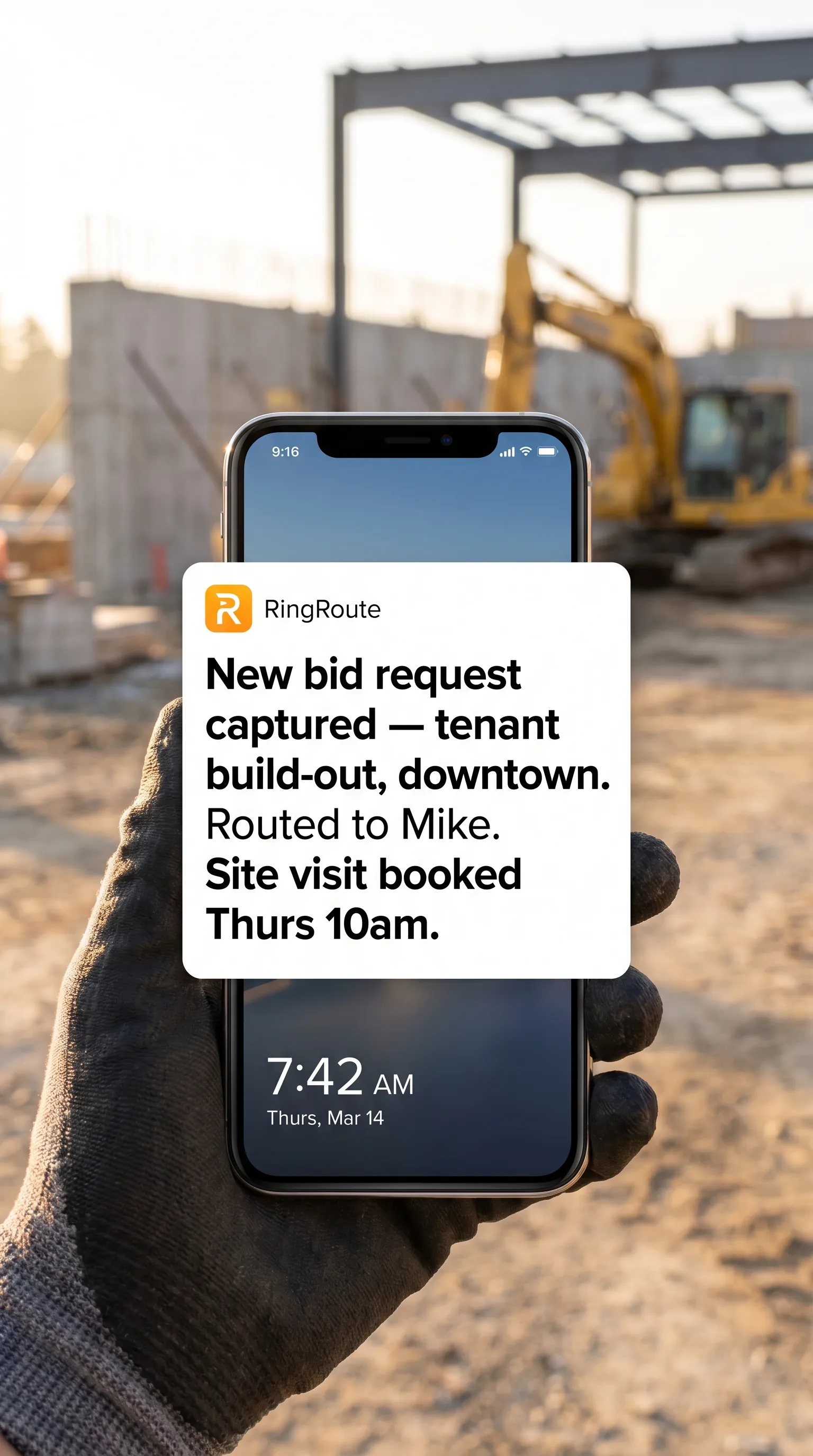
- Books the pre-bid walk directly into your calendar. "Mike's available Tuesday morning at 10am for a walk-through — would that work for you?" Calendar updates immediately. Owner gets confirmation. You're locked in before competitors even respond.
- Captures the brief. Owner's name, contact info, what they want built, what their timeline is, what kind of references they're looking for. So when you walk on-site you've already read the project summary.
- Detects high-priority leads. "Past client referral" + "specific neighborhood you work in" + "matching project type" = texts you NOW with "drop what you're doing if you can — this one's real." Window-shoppers and tire-kickers = captured and queued.
The estimating and contract decisions stay with you. The intake-qualification-booking workflow happens automatically.
What the GC on the jobsite actually wants
Talk to any active GC and they'll tell you the same thing: the worst part of being in the field isn't the work — it's missing the calls you'd actually want to take while you're swinging a hammer.
The friction is structural. You can't be on a roof AND in the office AND on the phone. Most GCs try to solve this with:
- Admin staff: works for the admin tasks but pushes phone responsibility back to you for actual estimating questions
- Live answering service: takes messages, but messages are useless when speed matters
- The classic "I'll call you back when I'm done at 5pm" approach: works on routine calls, loses you the high-value calls
AI fixes the speed problem (~3-second response) and the qualification problem (configured to YOUR project criteria — your geography, your size range, your specialty). The high-value bid calls reach you with full context; the wrong-fit calls get politely deflected without bothering you.
The seasonal multiplier
Construction has predictable surge windows: spring (homeowners planning summer projects), September-October (year-end-budget commercial work), and post-storm-event spikes (hurricane / hail / flood damage triggers a wave of repair inquiries).
The GCs who win those windows are the ones whose phones get answered when they ring. AI handles unlimited concurrent calls with the same triage logic regardless of load — the post-hurricane week where 80 storm-repair calls come in over 3 days is no harder than a normal Tuesday.
The real choice
Four options, all real:
- Voicemail and end-of-day callback. $0/month. You lose 6-10 projects per year, $480K-$2M+ in annual profit.
- Live answering service. $400-1,000/month. Polished voice, takes messages. Doesn't book your calendar, doesn't qualify the project.
- AI receptionist (RingRouteUSA tier). $149-$799/month flat. Configured for construction: project-type qualification, capacity-aware booking, on-call priority routing.
- Hire dedicated phone admin. $50-70K/year. Works during business hours, doesn't cover evenings/weekends without overtime.
Break-even is recovering 1 project per year out of the 6-10 you're missing. The math isn't subtle.
Try it on a real bid-request call
The fastest way to evaluate whether AI can actually handle a bid-request call while you're on a jobsite is to hear it take one yourself.
Talk to the RingRouteUSA AI now →
Try a scenario: tell it you got their name from a past client referral, you're planning a custom new home in their service area, your budget is roughly $1M, and you'd like to schedule a pre-bid walk-through. Listen to what it asks, how it qualifies the project, and whether you'd trust it to lock in a calendar slot before competitors can respond.
If it passes that test, the next step is configuring it specifically for your operation — your service area, your project type focus, your size range, your calendar system, your on-call routing. See the construction receptionist playbook →.
The custom-home bid sitting in voicemail is real profit. The math just isn't subtle.