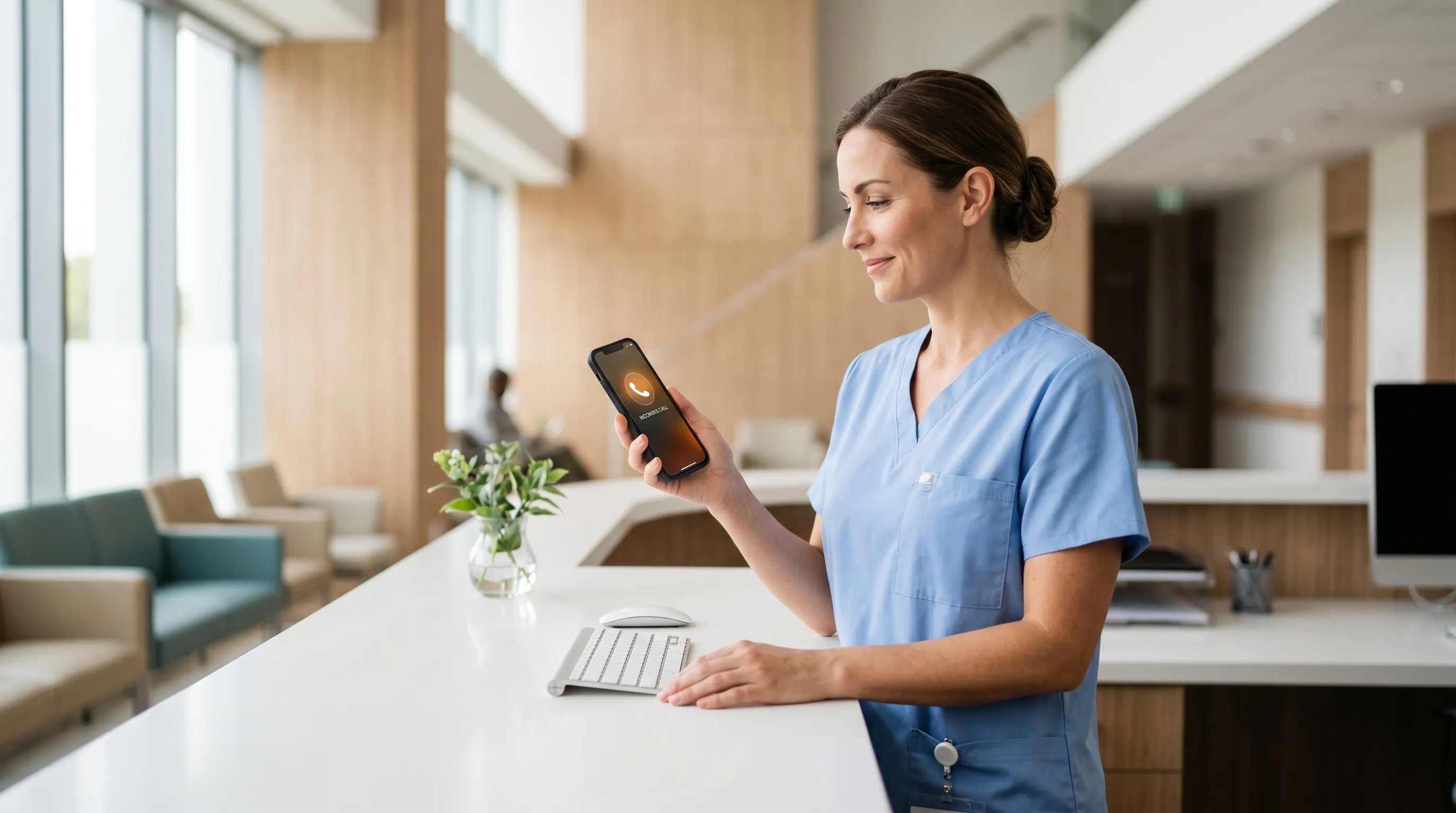
A new patient calls your clinic Wednesday at 4:38pm to ask if you accept BlueCross BlueShield and whether you can see them this week for what sounds like a sinus infection. Your front desk has three patients lined up for checkout and the call goes to your phone tree. The patient navigates two menu options, hits "press 4 for new appointments," and lands on a voicemail.
She doesn't leave a message. Most people don't. She calls the urgent care two miles away that picks up on ring two and gets seen at 6:15pm that same day.
Your clinic just lost a patient who would have generated ~$2,400 over the next 18 months in routine and follow-up care. From one missed call.
How often is this happening?
The single-call cost
Healthcare calls split across a few different revenue patterns. Walk through what a typical inbound new-patient or existing-patient call could be:
| Call type | Realistic value | Notes |
|---|---|---|
| New patient establishing care (PCP) | $300-600 first visit + $1,500-3,000 first-year revenue | New patient is the highest-value call type |
| Sick visit (urgent same-week need) | $200-450 | Often becomes a captured new patient |
| Specialist consult (cardiology, ortho, derm) | $400-1,200 first visit + follow-up | Often higher-acuity, longer relationships |
| Insurance verification ("do you take my Aetna?") | $0 direct, but books a visit if yes | The most-asked after-hours question |
| Existing patient sick (acute symptoms) | $180-400 visit + relationship preservation | Retention-critical |
| Refill request, billing question, lab result | $0-100 | Lower direct value, high frustration if mishandled |
| Telehealth booking | $120-220 + insurance | Increasingly common, increasingly time-sensitive |
The single-call value for a new-patient establishing-care call is $300-600 immediately + $1,500-3,000 in first-year revenue. For specialists or sub-acute patients, easily 2-3× higher.
The lifetime-value math
Healthcare patients are sticky. A patient who has a good first experience at a clinic typically:
- Stays for 6-12 years with the same primary care provider
- Generates $1,800-3,500/year in routine care + occasional acute visits
- Refers family members
- Stays through insurance changes if the experience is good
Conservative numbers per "rescued" new patient:
- First-year revenue: $1,800
- Annual recurring revenue: $1,200/year (steady-state)
- Average tenure: 6 years
- Lifetime value: ~$8,600 per patient
That's per individual patient. From a single missed inbound call.
For specialist practices (cardiology, orthopedics, ophthalmology, dermatology), the per-patient LTV is often 1.5-3× higher because per-visit revenue is higher.
How often this happens
Medical practice management research consistently shows:
- Independent medical practices miss 18-30% of inbound calls during business hours, depending on staffing + call volume.
- Voicemail callback rate from new patients: ~22%. Most callers go to whoever picks up.
- Lunch hour, end-of-day, and holiday weeks see miss rates above 40%.
- For after-hours specifically — evenings, weekends — voicemail is the default unless the practice pays for an answering service.
Conservative numbers for a small/mid practice (3-5 providers, ~30-50 calls/day):
- 4-8 missed calls per business day during work hours
- + 3-6 missed after-hours calls per week
- Total: ~1,200-2,400 missed calls per year
- If 20% would have been new-patient acquisitions:
- = 240-480 missed new patients per year
At ~$8,600 LTV per missed new patient:
- $2.0M - $4.1M in missed annual patient lifetime value for a single small/mid clinic.
For specialist practices or higher-acuity clinics, easily 2-3× these numbers.
The HIPAA-without-HIPAA-risk question
The first thing every medical practice owner asks: "Is this even allowed under HIPAA?"
Short answer: yes, when configured correctly.
Longer version:
- RingRouteUSA infrastructure is HIPAA-compliant. We sign Business Associate Agreements (BAAs) with healthcare customers — this is the legal mechanism that allows a vendor to handle protected health information.
- Patient information captured on calls (name, DOB, insurance, symptoms) is encrypted at rest and in transit, with per-tenant key separation.
- All audio + transcripts stored in US-East AWS under SOC 2 Type II controls.
- The AI can be configured to NOT capture specific PHI elements if your practice prefers (some practices want only name + callback number, never symptoms).
- See our security & compliance page for the full data-handling detail.
So the HIPAA question is real but solvable. The bigger risk is missing the call entirely.
What good AI does on the new-patient call
A generic phone tree forces the caller through menu navigation. A live answering service writes "called about new patient appointment — please call back." Neither captures the actual patient.
An AI receptionist configured for a healthcare practice does more:
- Verifies insurance acceptance in real time. "What's your insurance carrier? ... Yes, we do accept BlueCross BlueShield PPO plans. Let me check our availability." Removes the #1 friction point in new-patient acquisition.
- Books directly into your scheduling system. Athenahealth, Epic, eClinicalWorks, NextGen, ModMed — the AI can read availability and book the slot directly. No callback needed.
- Triages urgency appropriately. "Severe chest pain" → "Please call 911 or go to the nearest emergency room immediately." "Sinus infection symptoms for 3 days" → books a sick visit. "Annual checkup" → books a routine slot.
- Captures structured intake. Demographics, insurance, reason for visit, current medications (if you configure that), preferred provider — captured before the patient arrives so the front desk doesn't repeat the same questions.
- Handles refill + records-request workflows. Triages routine requests to the right queue without bothering a provider.
The clinical decisions stay with your team. The intake + scheduling workflow happens automatically.
What the front desk lead actually wants
Talk to any practice manager and they'll tell you the same thing: the phone is the number-one source of friction for the front desk team.
Patient checks in. Phone rings. Front desk picks up the phone while the patient stands waiting. Phone caller wants to ask about insurance. Front desk has the in-person patient frustrated. The phone caller is on hold. By the time the in-person patient is checked in, the phone caller has hung up and the in-person patient is annoyed.
AI fixes the constant-interruption problem. The front desk team focuses on the humans in front of them; the phone gets handled in parallel with the same level of competence.
The hard math
Four real options:
- Voicemail or phone tree. $0/month direct cost. You lose 240-480 new patients per year, $2-4M+ in lifetime value annually. Most practices accept this loss because they don't see it on a P&L line.
- Live answering service (healthcare-specialized). $400-1,200/month. Polished, often HIPAA-compliant. Takes messages, can sometimes book if integrated with your scheduling system. Hits limits during call surges.
- AI receptionist (RingRouteUSA tier). $149-$799/month flat. HIPAA-compliant, BAA available. Configured for healthcare: insurance verification, triage scripts, scheduling-system integration, on-call routing.
- Hire dedicated phone-only receptionist. $42-60K/year. Doesn't cover 24/7. Hard to retain.
Recovering even 3 new patients per year out of the 240-480 you're missing pays for any of options 2-4 for the year.
Try it on a real intake call
The fastest way to evaluate whether AI can actually handle a new-patient call is to hear it take one yourself.
Talk to the RingRouteUSA AI now →
Try a scenario: tell it you're a new patient looking for a primary care provider, you have BlueCross BlueShield PPO, you'd like to be seen this week for a sinus infection. Listen to what it asks, how it triages, and whether you'd trust it with your new-patient intake.
If it passes that test, the next step is configuring it specifically for your practice — your accepted insurance plans, your provider schedules, your triage protocols, your HIPAA requirements. See the healthcare receptionist playbook →.
The $2M+ in missed annual lifetime value is sitting in voicemail. The math just isn't subtle.