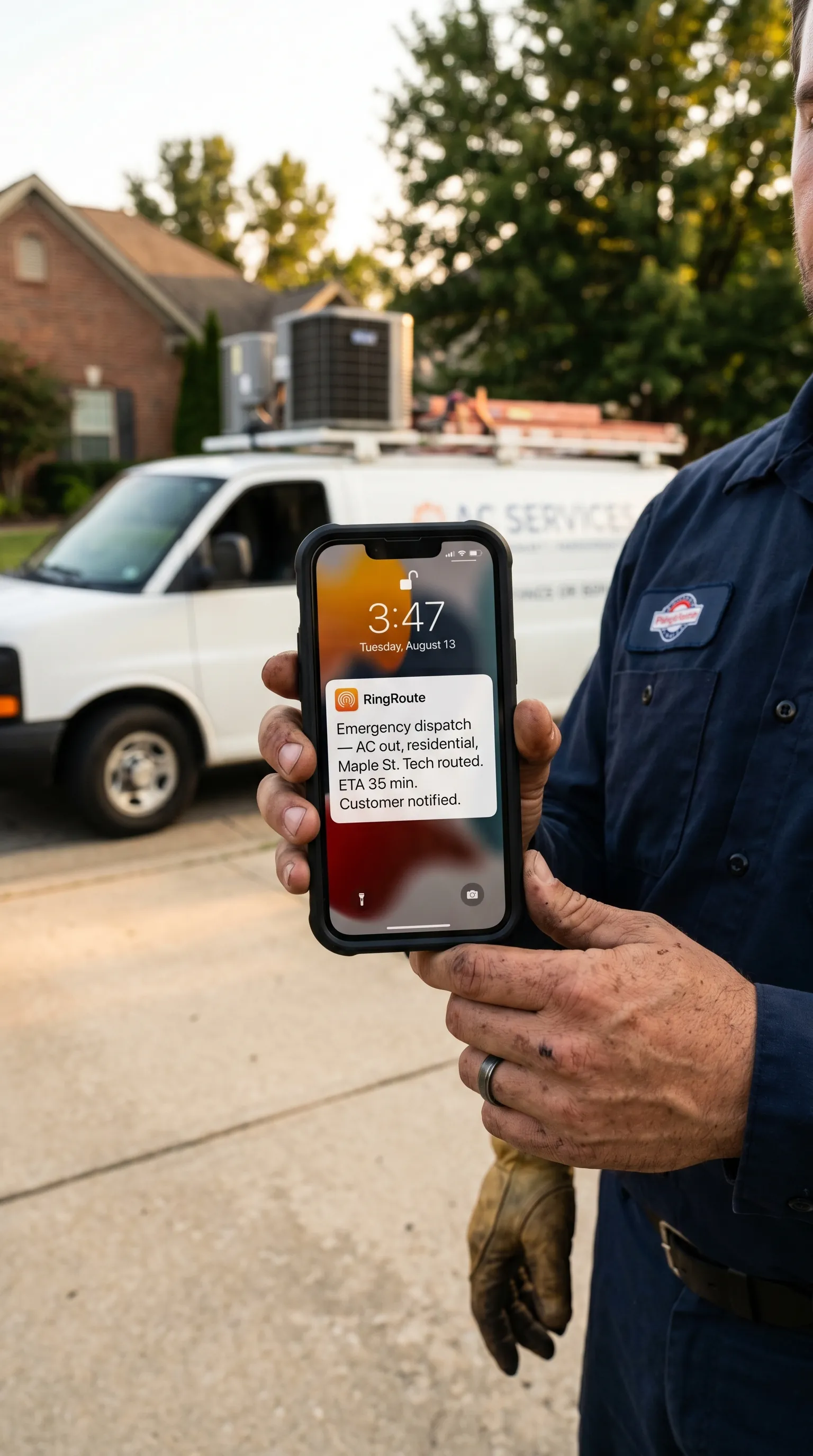
It's 2:14am Tuesday in January. The furnace in a 2,400-square-foot house in your service area stops working. The homeowner wakes up cold, finds the thermostat blank, panics, and pulls up Google on her phone.
She finds three HVAC companies that show up in her zip code. She calls the first one — voicemail. Calls the second — voicemail. Calls the third — a live voice picks up on the second ring.
The third company is on the call within 90 minutes. Emergency furnace replacement scheduled for first thing in the morning. The $4,200 system installation goes on the third company's books, plus the $1,800/year maintenance contract she signs three weeks later because they took care of her at 2am.
Your phone? Voicemail box. You'll see her call when you check messages at 7:30am, by which point it doesn't matter anymore.
How much did that miss cost?
The single-emergency-call math
HVAC emergencies aren't normal calls. The customer isn't shopping. They're not comparing quotes. They're choosing whoever can be there fastest — and whoever picks up the phone is the only company that gets to be there at all.
Walk through what a typical winter no-heat emergency call could be:
| Scenario | Realistic average ticket | Notes |
|---|---|---|
| Emergency furnace repair (igniter, control board, blower motor) | $450-1,200 | Plus emergency rate premium |
| Furnace replacement (full system, urgent) | $3,500-7,500+ | Often financed; immediate decision because they're cold |
| Frozen pipe + repair coordination | $300-800 + plumber referral | You become the "called us first" hero |
| AC failure (summer peak, 95°F+) | $300-800 | Same urgency dynamic, different season |
| Maintenance contract signup (post-emergency) | $300-1,200/yr × 5-10 years | Customer who got "rescued" stays loyal |
The single emergency-call ticket on a January no-heat or July no-AC situation is often $1,000-2,000 minimum, with frequent escalation into full system replacement when an old unit dies. That's the IMMEDIATE revenue.
But the bigger number is what follows.
The lifetime-value math
A homeowner who calls in an emergency and gets rescued becomes a customer for the full remaining lifetime of their HVAC system — typically 8-15 years for a furnace, 10-15 for an AC unit.
Conservative numbers per "rescued" customer:
- First-call ticket: $1,500 (mix of repair vs replacement)
- Annual maintenance contract: $400-800/yr
- Year-over-year retention: ~85% (high — they trust you because you showed up)
- 8-year customer lifetime: ~$1,500 + (8 × $600) = $6,300 average
- 12-year lifetime if they replace the system with you: ~$10,000+
That's per rescued homeowner. From a single after-hours call you would have missed.
And it compounds further — happy emergency customers refer neighbors. The "we'll call them, they came at 2am for us" word-of-mouth in a residential neighborhood is one of the strongest lead sources HVAC companies have.
How often this is actually happening to you
Industry data from HVAC dispatch software vendors:
- Independent residential HVAC companies miss 20-40% of after-hours emergency calls during peak season weeks (mid-July to mid-August for AC, mid-December through February for heat).
- The miss rate is functionally 100% for any call outside business hours unless you have a live answering service or dedicated on-call dispatcher.
- "First to answer" wins 60-75% of emergency calls in residential markets. The second-place company usually gets nothing.
Conservative back-of-envelope:
- 4-8 emergency after-hours calls per week during peak seasons (16-week peak windows: 6 weeks summer + 10 weeks winter)
- Off-peak weeks: 1-2 emergency after-hours calls per week (36 weeks)
- Total per year: ~150-250 after-hours emergency calls
If 30% would have converted to immediate-ticket customers with a real pickup:
- ~60 missed rescued-customer relationships per year
- 60 × $6,300 LTV = $378,000 in missed customer lifetime value annually
The conservative version. Higher-ticket markets (high-end residential, custom commercial) easily double these numbers.
What good AI does on the 2am call
Here's where HVAC is different from a generic answering service: the call needs routing decisions, not just messages.
A live answering service writes "call back at 8am about heating issue." An AI receptionist configured for HVAC does more:
- Distinguishes emergency from non-emergency. "No heat" + "won't turn on" + "started smelling like" + "smoke" → escalates to on-call tech immediately. "When can someone come for a tune-up?" → captured and queued for normal scheduling.
- Captures structured intake. Address, system type (gas/electric/heat pump), system age if known, what just happened, when they last had it serviced, whether it's a tenant or owner, contact preference. So the tech rolling out at 2:30am has the full picture before they're in the truck.
- Provides immediate confidence. "I'm dispatching a technician now. You should expect a call from them within 20 minutes to confirm exact ETA. In the meantime, please turn off the system at the breaker to prevent any further damage." The customer feels handled.
- Routes to the right person. Your on-call rotation — Tuesday night = Mike, Wednesday = Jess. The AI knows the schedule and texts the right tech with the full transcript.
The decision logic isn't AI's job — it's configured against YOUR dispatch protocols. The AI executes consistently every time. No more "we missed the emergency because the call went to the answering service who took a message instead of paging Mike."
What the on-call tech actually wants
Talk to any solo or small-team HVAC contractor on the on-call rotation and they'll tell you the same thing: the worst part isn't the real emergencies. It's getting woken up for non-emergencies.
The "my pilot light is out, can I light it myself?" call. The "I think I need a new thermostat" call. The "what time do you guys open?" call. The "can I move my Thursday appointment to Friday?" call.
Most of those don't need a tech mid-sleep. They need a competent voice that captures the info, gives appropriate reassurance, and routes to the next morning. AI that does this saves the on-call rotation more pain than it solves on emergencies — because there are far more non-emergencies than real ones, and they all come from the same after-hours number.
The contractors who try AI receptionists almost universally report: "I'm sleeping through the night again. The actual emergencies still wake me up. But the 11pm 'how do I reset my thermostat' calls don't."
The peak-season multiplier
Here's the brutal arithmetic of HVAC: most of your annual revenue comes from a few brutal weeks per year.
A heat wave that hits a metro area on a Wednesday in July creates 50-100 simultaneous AC failure calls across your service area between 6pm and 11pm. The same is true for a hard freeze in January for heating systems. Your phone is going to ring more in those 5 hours than it does in the previous two weeks combined.
The companies that win peak-season weeks are the ones whose phones get answered:
- Live human dispatcher in office: hits limits fast, expensive, hard to staff 24/7
- Live answering service: works for moderate volume, falls over in true peak surges (their call center hits the same overflow)
- AI receptionist: handles unlimited concurrent calls, every one of them gets the same triage logic regardless of load
This is why "unlimited concurrent calls" matters more for HVAC than for almost any other vertical. A normal week sees 4-8 after-hours emergencies. A peak heat-wave week sees 40-80 in a single evening. The system that scales to peak without overage charges wins the season.
The real choice
Four options, all real:
- Voicemail (status quo). $0/month. You miss ~60 customer relationships and ~$378K LTV per year. First-to-answer competitors get them.
- Live answering service ($400-1,000/month). Works for normal weeks. Hits caps and overflow during peak. Triage is generic, not configured to your dispatch protocols.
- AI receptionist (RingRoute USA tier) $149-$799/month flat. Unlimited concurrent calls during peak. Configured with your emergency keywords + dispatch routing + on-call schedule.
- Dedicated dispatcher ($55K-75K/year salary + benefits). Works only during business hours unless you pay for night shift. Hard to retain.
The break-even on options 2-4 is absurd: recover even two rescued customers per year out of the 60 you're missing, and any of them pays for itself for the year. The only question is which fits your operation.
Try it on a real call
The fastest way to evaluate whether AI can actually handle a 2am no-heat call is to hear it take one yourself.
Talk to the RingRoute USA AI now →
Try a scenario: tell it you're calling at 2am with no heat, that it's January, and you've got a baby in the house. Listen to what it asks, how it routes the call, and whether you'd trust it to text your on-call tech with the right priority.
If it passes that test, the next step is configuring it specifically for your operation — your emergency keywords, your dispatch rotation, your service area. See the HVAC receptionist playbook → for what that configuration covers.
Peak season is 5-12 weeks away depending on your market. The companies whose phones are answered when the first heat wave or cold snap hits are the ones whose books are full all season.